
by Rev. Dr. Bob Molsberry
July 12, 2026
Trinity United Church of Christ, Marengo – Installation of Rev. Daniel Luepke
Luke 4:16-21; Acts 2:42-47
(Today’s Reflections is shared by Rev. Dr. Bob Molsberry. It is the sermon he gave for the installation of Pastor Daniel Luepke to Trinity UCC in Marengo, IA. Rev. Dr. Bob Molsberry is a Conference Deacon for the Iowa Conference of the UCC.)
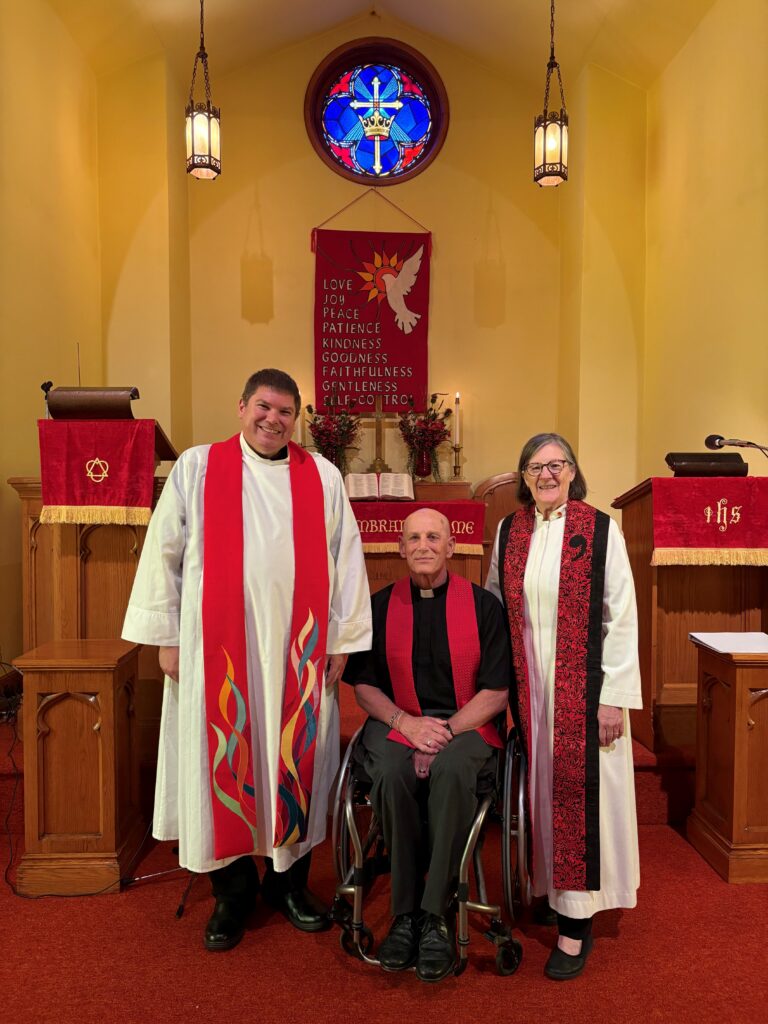
at Pastor Luepke’s Installation at Trinity UCC, Marengo, IA.
In 1994 my family returned to Iowa after serving 3 years in Nicaragua with the Mennonite Central Committee and 3 years in Guatemala in the Peace Corps. I had sensed that during my absence, ministry in the United Church of Christ had changed, and as I talked with the Iowa Conference staff about serving a local church, I proposed some radical, creative forms of ministry. I asked the Conference Minister if he thought that was a good idea. He said, “Bob, I have no idea what works anymore. Everything has changed. We’re making it up as we go along. Whatever you want to do, give it a try. Let me know what you learn.” And those were the wisest words of advice I have ever received.
Raised up in churches in the 1950s, trained in professional ministry in the 1970s, everything I ever knew or learned about ministry has been rendered obsolete. The only skill I learned that has lasting value is the practice of learning how to learn as I go along.
Back in the 1950s, those optimistic years following WW2, churches and other organizations were booming. The Lions, the Elks, the Kiwanis. Churches. It was assumed that “if you build it, they will come.” Big new church facilities were built on cheap land at the edge of town. Older buildings added four-story educational wings. And filled them every week with kids!
But demographics and cultural norms have changed since then.
Think of the changes right here in Iowa County since the founding of the three German Reformed congregations here in 1888. The intrepid pioneers planted three small congregations to serve the local settlers, mostly farmers. St. John’s, St. Paul’s, and Zion. The Marengo Charge. The families they served clumped around the congregations on small family farms. When I met with some of you here a couple of years ago, we calculated that there might have been 10 farms of a few acres each within a mile walk of the church, and some of these families might have had 10 kids each. Think of the Sunday morning worship gatherings and Sunday afternoon picnics and Wednesday night prayer services when all the neighbors got together! Folks just walked across the field or down the road to get here.
But then: CHANGE! Farms needed to get bigger to be economically viable. 40 acres and a mule would no longer cut it. Rural populations declined. Schools consolidated and kids were bused into town. During my lifetime the interstate was cut right through middle of Iowa farmland and communities, cutting off neighbors and small towns. Churches learned to cooperate and then to consolidate just like the schools. The three Iowa County Reformed churches became one. The denominations merged: the German Reformed denomination merged with the German Evangelical Synod to become the Evangelical and Reformed Church, and then in 1957 joined with the Congregational and Christian Churches to become our United Church of Christ. And now, here locally you are sharing ministry and pastoral leadership with First Lutheran Church of Conroy. The changes might not have felt neutral. For many people it has felt like loss. There has been a significant decline in numbers of members and congregations, and a significant shrinkage in state and national administrative structures that I’ve experienced over nearly 50 years of ordained ministry. Some people look back over that history with a sense of nostalgia and even grief over what has been lost. Ministry needs a radical reboot to address current needs and trends.
But let’s go back a little farther in history, to the very beginning of a fledgling church in Jerusalem. We read in the book of Acts about the birthday of the church on Pentecost. Members met weekly in homes. They shared all things in common. They met the needs of their neighbors. They shared with gladness so that the saints of the church were cared for. They followed in the way that Jesus had pioneered for them: feeding the poor, welcoming the stranger, clothing the naked, releasing the captive, healing the sick.
In that sense, nothing has changed about ministry in the last 2000 years. Now and forever, world without end, ministry is the same animal it was 2000 years ago. Neighbors gather to worship and break bread together. To reconnect with one another and remind each other about the love of God which passes all understanding. They learn from the Bible about Jesus’ ministry of reconciliation, justice, compassion, and welcome to which Jesus devoted himself. And they pledge to dedicate themselves to that same ministry.
You do that same ministry in countless creative and entrepreneurial ways, through Bible studies over coffee, after school programs, supplying food pantries, showing up for a small town parade, worshiping with your neighbors across the county, whether in your church or your neighbor’s church, raising mission money for natural disasters in Venezuela or human disasters in Sudan, visiting the sick, praying for your neighbors and nation, singing in a choir, supplying clothing closets, sending kids to church camps, cleaning up litter on the roadsides – you know the drill. Whatever it takes to build up the Kingdom of God, as God might have imagined it for the world, that’s what you do, together, with joyful and gladsome hearts. We pray it every Sunday: “Thy kingdom come on earth,” and then we get busy BEING the Kingdom, as best we are able, along with our neighbors.
I like to imagine ministry in this changing environment like an amoeba. Do you remember watching amoebas under the microscope in high school biology class? The way they explore their environment is by extending a pseudopod out into the world to test the waters, so to speak. If they encounter a barrier or a toxic or hostile environment, they withdraw the pseudopod and strike out in a different direction. Until they find a more productive, fruitful direction in which to travel.
Be an amoeba. Play with various ministries. They won’t all work, but don’t be afraid to fail. Even Caitlin Clark misses more shots than she makes! Frequent failure is the price of success.
You know how your GPS tells you where to go? “At the next stoplight, turn left.” And if you deviate from her chosen route, she will redirect you back to the original route. But if you really get lost, she says, “recalibrating.” She’s planning a whole new route for you to get to the original destination from the new place that you’re at.
That’s what church is doing these days. Recalibrating. It’s a unique starting point now, because we’ve never been here before. We are not on the same route we were on 50 years ago, or 2000 years ago. But the destination, the goal, is that same it’s always been. We are seeking to be faithful to God’s invitation to discern and to live the Kingdom of God right here in our midst.
The sweet spot for creative, effective ministry is when your skills and passions meet the world’s needs. That’s where effective change happens. And that’s when God smiles.
May God smile on the pastoral leadership of Rev. Daniel Luepke and the ongoing ministry of Trinity United Church of Christ!